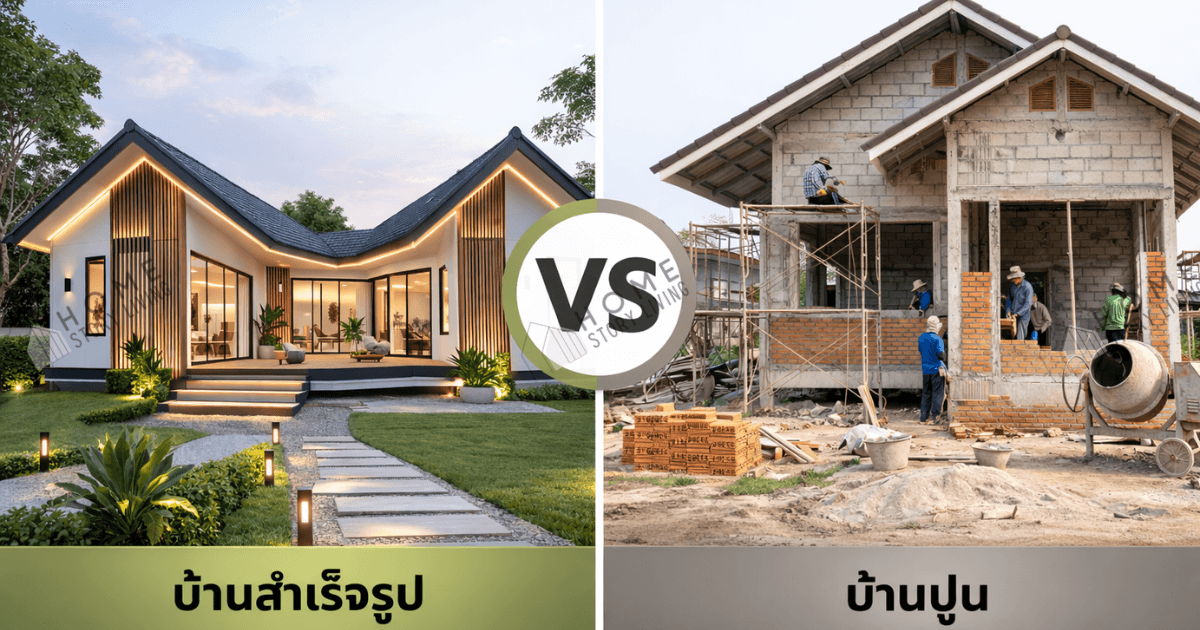
Many people planning to build a house in 2026 often face the same question: "Should I build a traditional concrete house, or choose a prefabricated house?" There's no definitive right or wrong answer; it depends on your budget, time, location, and lifestyle.
This article will provide a straightforward comparison of both options, along with updated price information for 2026, and explain the differences between prefabricated houses, knockdown houses, and modular houses, which many people still find confusing.
Understanding the Basics: What are the Differences Between Prefabricated, Knockdown, and Modular Houses?
Before comparing them to concrete houses, it's essential to understand that "prefabricated houses" aren't all the same. They are divided into three main types, each with different manufacturing processes and strengths.
Prefabricated House (Prefab House)
A prefabricated house is a house where all structural components are manufactured in a factory, including steel frames, walls, roofs, and floors. About 70% – 80% is assembled at the factory, depending on the complexity of the house design. It is then transported to the site for final completion.
If you want to move a prefabricated house to a new location after it has been installed for a customer, approximately 10% – 15% of the structure may be damaged during the moving process, requiring repairs at the destination. This is similar to prefabricated houses abroad that can be moved, but require adjustments. Therefore, prefabricated houses are suitable for tailor-made designs that require high levels of customization.
Knockdown House (Knockdown House)
A knockdown house is a house that is completely built at the factory and transported for immediate placement on the site. Minimal finishing work is required. A significant advantage is that it can be moved to a new location more easily than a prefabricated house because it is designed to be disassembled from the start. This is ideal for those who want a ready-to-move-in home and may need to relocate in the future.
Modular House (Modular House)
A modular house has a manufacturing process similar to that of a prefabricated house. All structural components are manufactured in a factory, and 70% – 80% is assembled at the factory as well. However, the distinct advantage is that customers can choose different sized "boxes" (modules) to assemble like jigsaw puzzles. To expand the area, add more boxes; to reduce it, remove boxes. The house size increases according to the number of boxes pre-determined, making it flexible in layout and easier to expand the house in the future compared to other types.
In the Thai market, they are often collectively referred to as knockdown houses.
Summary of the 3 Types
Topic | Prefabricated (Prefab) | Knockdown | Modular |
|---|---|---|---|
Assembly at Factory | 70 – 80% | 100% | 70 – 80% |
On-Site Finishing | 20 – 30% | Very Minimal | 20 – 30% |
Ease of Relocation | Relocatable, but 10-15% Damage | Easiest to Relocate | Relocatable, but Some Damage |
Design Flexibility | Highly Tailor Made | Limited by Design | Choose Boxes to Assemble Like Jigsaw |
Future Expansion | Adjustable | Limited | Easy to Add Boxes |
Suitable For | Those Wanting Custom Designs | Those Wanting Quick Move-In | Those Wanting High Flexibility |
Aesthetic Design | Can be designed beautifully in many styles | Not very beautiful, usually square shapes with limited design options. | Can be designed beautifully and in many styles |
What is a Conventional Concrete House?
A concrete house is a house built using the traditional brick-laying and plastering method, using reinforced concrete structures. Every step, from pouring the foundation to building walls, plastering, laying floors, and roofing, is done entirely on-site. This relies heavily on skilled labor and takes a long time, but offers very high design flexibility and a strong, durable structure.
Major Comparison Table: Prefabricated vs. Concrete Houses in 2026
Comparison Topic | Prefabricated / Knockdown / Modular House | Concrete House |
|---|---|---|
Price per Sq.M. | 6,000 – 25,000 Baht | 14,000 – 25,000 Baht |
Construction Time | 15 – 60 Days | 4 – 8 Months |
Assembly at Factory | 70 – 100% (Depending on Type) | 0% (All On-Site) |
Strength | Good Strength (Galvanized Steel Frame) | Very Strong (Reinforced Concrete) |
Lifespan | 20 – 40+ Years | 30 – 50+ Years |
Heat Insulation | Very Good (If Using PU Foam Insulation) | Moderate (Depends on Wall Material) |
Construction Permit | Required Like Regular House | Same Requirement |
Design Flexibility | Moderate – High (Modular = Jigsaw) | Very High (Free Design) |
Later Additions | Possible (Modular Adds Boxes) | Easily Done |
Relocation | Relocatable (Knockdown Easiest) | Not Relocatable |
Resale Value | Moderate | High |
Risk of Contractor Abandonment | Very Low (Factory Production) | High (Relies on Skilled Labor) |
Quality Control | Consistent (Factory Standard) | Variable (Depends on Skill) |
In-Depth Analysis of 5 Key Dimensions Before Deciding
1. Price and Budget: Which is Truly Cheaper?
For concrete houses in 2026, the average price is around 14,000 – 25,000 Baht per square meter, depending on the grade of materials and the complexity of the design. However, this price often doesn't include "hidden" costs, such as design fees, site supervision fees, and costs for correcting errors made by workers.
Prefabricated, knockdown, and modular houses have a wider price range, starting from 6,000 Baht/sq.m. for economical knockdown houses, up to 22,000 – 25,000 Baht/sq.m. for premium modular houses that use high-quality materials like PU Foam Injection, Low VOC paint, and Solar Cells.
Real Comparison Example: House size of 120 sq.m.
Mid-grade concrete house: Approximately 1.7 – 2.0 million Baht (excluding design fees and contingency costs)
Standard knockdown house: Approximately 1.2 – 1.4 million Baht (often includes transportation costs)
Prime modular house: Approximately 2.6 – 3.0 million Baht (includes PU Foam innovation and high-quality materials)
Caution: Some prefabricated house prices may not include foundation, electrical, plumbing, and transportation costs. Be sure to inquire about the details before making a decision.
2. Construction Time: How Much Faster?
This is where prefabricated houses clearly win.
Concrete houses take 4 – 8 months to complete, not including the design phase, permits, and potential delays due to weather or unpredictable labor issues.
Prefabricated and modular houses take about 30 – 40 days to manufacture in the factory, then another 10 – 15 days for on-site finishing work. In total, from order to move-in, it takes no more than 45 – 60 days.
Knockdown houses are the fastest because they are 100% completed at the factory, transported to the site, and require minimal finishing work. You can potentially move in within 15 – 30 days from the order date.
For those who need a house urgently, such as building a vacation home, a resort for business, or facing a deadline on a land lease contract, choosing a factory-built house is a much better solution.
3. Strength and Lifespan: Which House is More Durable?
Most people worry that prefabricated houses are not as strong as concrete houses. In reality, it depends on the grade of materials and manufacturing standards.
Concrete houses that use reinforced concrete structures according to engineering standards have a lifespan of 30 – 50 years or more. However, they require maintenance for cracks, leaks, and termites, which are long-term costs that many people overlook.
Premium prefabricated houses that use rust-proof galvanized steel frames and PU Foam insulated walls have a lifespan of 20 – 40 years or more. Especially models that use PU Foam Injection technology, the walls feel as solid as brick when tapped, not flimsy like some people mistakenly believe.
What needs to be considered is that factory-built houses have consistent quality because they are produced according to the same standards for every unit. This is different from concrete houses, where quality varies depending on the skill of individual workers and the weather conditions on the day the concrete is poured.
4. Heat Insulation and Energy Saving: How Much Do Electricity Bills Differ?
In Thailand's hot climate, heat insulation is a crucial factor that directly affects monthly expenses.
Typical concrete houses absorb heat during the day and slowly release it in the evening, making the house hot and stuffy even after sunset. This requires constant air conditioning, resulting in high electricity bills.
Prefabricated houses that use PU Foam Injection technology insulate heat 4 – 10 times better than typical concrete walls because the dense foam insulation inside the walls acts as a barrier to heat transfer. This helps save 30 – 50% on electricity bills compared to concrete houses without heat insulation. With the addition of Solar Cells, monthly electricity bills can be almost zero.
When considering the electricity savings over the lifespan, it may be worth the price difference in construction costs.
5. Risks to Consider: What Could Actually Happen?
Risks of Concrete Houses:
Contractor abandonment during construction — the number one fear of those building a house.
Budget overruns due to material price increases during the 4 – 8 month construction period.
Variable work quality depending on the skill of individual workers.
Shortage of skilled labor in 2026.
Risks of Prefabricated / Knockdown / Modular Houses:
Must choose a reliable manufacturer with a real factory and demonstrable results.
Must verify if the price includes foundation, electrical, and plumbing costs.
Inexpensive knockdown houses may use low-grade materials. Pay close attention to specifications, especially for steel, which may not meet standards, and wide steel joist spacing. Wall may use thin and widely spaced steel, making it not strong
Relocation, even if possible, involves costs and potential damage that must be accounted for.
Which Type is Right for You?
Choose a Concrete House If:
You want 100% free design according to your imagination, with no shape limitations.
You can wait 6 – 12 months without being rushed.
You have a trusted contractor and can supervise the site yourself.
You want the highest resale value.
You are building a permanent house that you will not need to move.
Choose a Prefabricated (Prefab) House If:
You want a custom house design (Tailor Made) but don't want to wait long.
You want consistent quality from factory standards.
You may need to move the house in the future (accepting some repair costs).
Choose a Knockdown House If:
You want to move in as quickly as possible, within 15 – 30 days.
You want a house that is easy to relocate, with convenient disassembly.
You have a limited budget and want to know the exact price from day one.
You can accept square-shaped house designs that may not be as aesthetically pleasing as prefabricated and modular houses.
Choose a Modular House If:
You want flexibility in layout, choosing boxes to assemble like jigsaw puzzles.
You plan to expand the house in the future (adding boxes).
You want an innovative house with good heat insulation and energy saving features.
You are building a resort, vacation home, or a house on land in a different province.
Frequently Asked Questions (FAQ)
Q: Do prefabricated houses require a construction permit? A: Yes, they do. According to the 2026 law, all types of houses, whether concrete, prefabricated, knockdown, or modular, are considered "buildings" that require a construction permit (Section 21) or construction notification (Section 39 Bis).
Q: Can I get a bank loan for a prefabricated house? A: It is more difficult than for concrete houses in general because banks may assess a lower value. However, there are other options, such as installment plans with the manufacturer or personal loans.
Q: Are knockdown houses hot? A: It depends on the materials used. Inexpensive knockdown houses with thin steel walls will be very hot. However, if walls with PU Foam insulation or heat insulation are used, they will be cooler than concrete houses because the insulation provides better heat resistance than concrete.
Q: What is the difference between modular and prefabricated houses? A: Both are about 70-80% assembled at the factory. However, modular houses allow customers to choose different sized "boxes" to assemble like jigsaw puzzles for easy expansion in the future, while prefabricated houses emphasize tailor-made designs.
Conclusion: Prefabricated vs. Concrete Houses in 2026
Both types have different advantages and disadvantages. There is no "best" answer, only the answer that is "most suitable for you." The important thing is to consider your budget, timeframe, location, need for future relocation, and lifestyle.
In 2026, with the shortage of labor, fluctuating construction costs, and the growing trend of Green Homes, all three types of factory-built houses are becoming increasingly attractive options, especially modular houses that offer both the flexibility of a jigsaw puzzle and energy-saving innovations.
If you are interested in modular or premium prefabricated houses that use heat-resistant PU Foam Injection technology with quality materials from SCG, TOA, and Bluescope, you can view house designs and calculate estimated prices at Home Story Living Prime or call our team for a free consultation at 081-882-3730.
 Chat on LINE